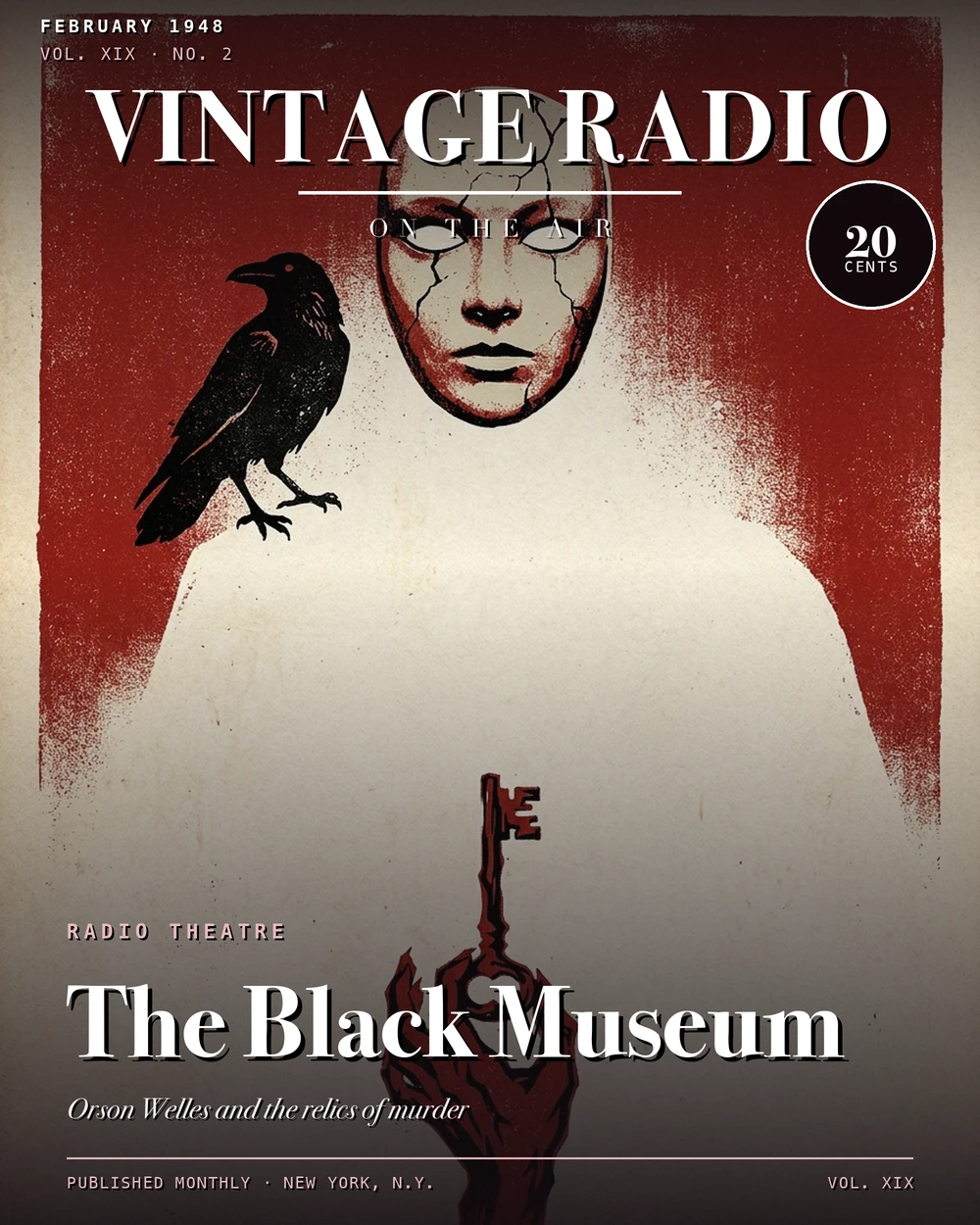
The Black Museum
Scotland Yard's Mausoleum of Murder
The premise is simple and genuinely unsettling. Scotland Yard keeps a museum — not of heroes or trophies, but a repository of crime, room after room of ordinary objects that each played a role in a murder or in bringing a killer to justice. A straight razor. An old trunk. A hammer. A cigarette lighter. A sash cord. Things you'd find in any home, each one carrying a story that ends badly for someone.
That's the world Orson Welles walked listeners through each week. As host and narrator, he moved through the empty museum, paused at an object, picked it up, and told its story. Every episode opened the same way — Big Ben chiming in the background, then that familiar voice: "This is Orson Welles, speaking from London." At the close, he reached back to his Mercury Theater days to sign off: "Now until we meet again in the same place and I tell you another tale of the Black Museum, I remain, as always, obediently yours."
The real Black Museum exists. Scotland Yard opened it in 1875 as the oldest museum in the world devoted purely to recording crime, and a reporter for The Observer coined the nickname two years later. It was never open to the public — its purpose was police training — but its catalog of evidence was rich enough to anchor an entire year of radio.
How It Got Made
The production story is stranger than the show ever let on. Although it was commonly taken to be a BBC program, The Black Museum was actually produced independently by Harry Alan Towers under his Towers of London label, and the dramatic performances weren't recorded in London at all. They were recorded in Sydney, Australia, by Creswick Jenkinson, using a top-line Australian cast — the first radio series produced in Australia this way. Welles cut his introductions and narration on tape in London, and those tapes were physically flown to Sydney to be married to the local recordings. The seam never shows.
The series ran as a transcription on Mutual from January 1 through December 30, 1952, Tuesdays at eight, carried on more than five hundred Mutual stations. The full syndication package was fifty-two episodes; thirty-nine aired over Mutual in two stretches, January through June and September through December. After Mutual, the show moved to Radio Luxembourg starting May 7, 1953, sponsored by Dreft and Mirro — both cleaning products beamed at England, since the state-owned BBC carried no commercials. The BBC itself didn't broadcast the series until 1991. The show also kept turning up on AFRTS broadcasts and U.S. NPR stations through the 1960s, '70s, and '80s.
Scriptwriter Ira Marion, a radio veteran whose previous credits included Crime Does Not Pay and The Blue Playhouse, handled the dramatizations. Cast members went uncredited on the original broadcasts; later research has identified Robert Rietti in lead roles, Keith Pyott as a frequent presence, and Australian Joe McCormick and American Harp McGuire among the regulars. Music was composed and conducted by Sidney Torch, a British pianist, cinema organist, and light-music composer who would go on to lead the BBC Concert Orchestra and create Friday Night is Music Night, a BBC Light Programme institution that ran more than fifty years. Torch's Black Museum score was good enough to be reused in the 1955 British film They Can't Hang Me.
Why Welles Made It Work
Radio gave Orson Welles a space he used better than almost anyone. His voice had weight and patience, and a show built entirely around a narrator walking through an empty room needed both. He wasn't playing a character; he was a guide, and the best guides know when to let silence do the work. The objects were the real subjects of each episode, and Welles treated them that way — holding them up, so to speak, and letting their histories speak for themselves.
Welles wrote none of the scripts — his involvement was limited to hosting and narrating — but his presence shaped everything around him. He was based in Europe at the time, partly because of personal and professional difficulties in America, including tax obligations to the IRS, which made him available for Towers's London productions. The two had first crossed paths in 1947 in the cutting room of The Lady from Shanghai, and after The Third Man turned Harry Lime into a fixture, Towers built a small empire of Welles-fronted radio around him. The Lives of Harry Lime came first. The Black Museum followed.
Contemporary reviewers noticed what he was doing. Variety called the show "solidly scripted and pervasively performed," and credited Welles's narration with adding "additional horror values" and creating "an appropriate clammy atmosphere." TV-Radio Life observed that the narration was "well placed and served to help the listener understand what was going on without taking the place of action."
Objects, Cases, and Competition
Every episode took its title from the artifact at the center of the case — "The Tartan Scarf," "A Piece of Iron Chain," "Frosted Glass Shards," "A Khaki Handkerchief," "The Bathtub," "The Bed Sheet," "A Tan Shoe, Left Foot," "The Gas Receipt." The names of real people in the cases were typically changed, but the underlying facts stayed true to the historical record. One episode, "The Letter," broke the pattern entirely — the only story not about murder, but about forgery.
The show had a near-twin on the air at the same time. NBC's Whitehall 1212, written and directed by Wyllis Cooper and hosted by the actual curator of Scotland Yard's museum, covered many of the same cases and ran nearly parallel to The Black Museum. The difference was in the telling. Whitehall 1212 stuck strictly to the police perspective. The Black Museum dramatized the murders themselves, scenes and all, including the criminal's point of view — closer to fiction in its methods, even when the underlying case was real. It's part of why some writers now point to it as a forerunner to the modern true-crime podcast: the willingness to put a listener inside a real crime, not just outside it looking in at a procedural.
It was also one of four Scotland Yard radio series Towers produced under the Towers of London label, alongside Secrets of Scotland Yard with Clive Brook, Fabian of the Yard, and Whitehall 1212 itself. Towers kept finding new ways to mine the same vein, and The Black Museum turned out to be the most durable of them: in 2002 he produced a television adaptation, Orson Welles Tales from the Black Museum, that used Welles's original narration over newly filmed noir dramatizations, with Michael York starring in the pilot as Inspector Russell. Half a century after the tapes flew from London to Sydney, the voice was still doing the work.